Haarlem-based artist caters to a global niche with melancholic pop
Hunter Complex: ‘I want to make music that explores’
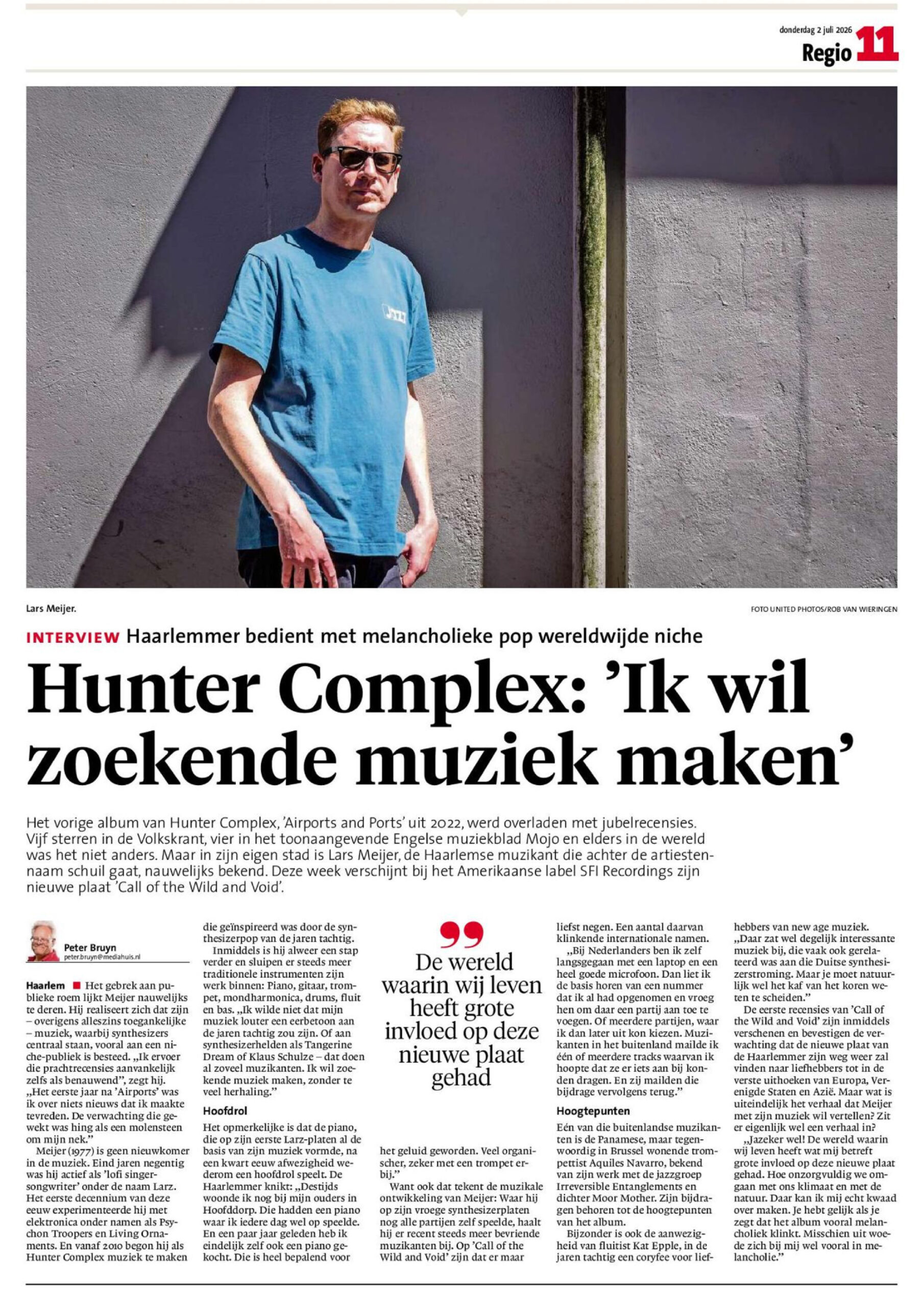
Hunter Complex’s previous album, ‘Airports and Ports’ from 2022, was showered with rave reviews. Five stars in De Volkskrant, four in the leading British music magazine Mojo, and the response was no different elsewhere in the world. Yet in his own city, Lars Meijer – the Haarlem-based musician behind the stage name – is hardly known. This week, his new album ‘Call of the Wild and Void’ is being released on the American label SFI Recordings.
The lack of public fame seems to bother Meijer very little. He realises that his music – which is, incidentally, thoroughly accessible – centred around synthesisers, is primarily aimed at a niche audience. ‘At first, I actually found those rave reviews quite stifling,’ he says. ‘In the first year after Airports, I wasn’t satisfied with anything new I made. The expectations that had been raised hung around my neck like a millstone.’
Meijer (1977) is no newcomer to the music scene. In the late 1990s, he was active as a ‘lo-fi singer-songwriter’ under the name Larz. During the first decade of this century, he experimented with electronic music under names such as Psychon Troopers and Living Ornaments. And from 2010 onwards, as Hunter Complex, he began making music inspired by 1980s synth-pop.
He has now moved on a step further, and more and more traditional instruments are finding their way into his work: piano, guitar, trumpet, harmonica, drums, flute and bass. ‘I didn’t want my music to be merely a tribute to the 1980s. Or to synth heroes like Tangerine Dream or Klaus Schulze – so many musicians are already doing that. I want to make music that explores, without too much repetition.’
Leading role
What’s remarkable is that the piano, which already formed the basis of his music on his first Larz records, is once again playing a leading role after a quarter of a century’s absence. The Haarlem-based musician nods: ‘Back then, I was still living with my parents in Hoofddorp. They had a piano that I’d play every day. And a few years ago, I finally bought a piano of my own. It’s become a defining element of the sound. Much more organic, especially with a trumpet added.’
For that, too, characterises Meijer’s musical development: whereas on his early synthesiser records he played all the parts himself, he has recently been bringing in more and more musician friends. On ‘Call of the Wild and Void’, there are no fewer than nine of them. A number of them are well-known international names.
‘For the Dutch musicians, I visited them in person with a laptop and a very good microphone. I’d play them the basic track of a song I’d already recorded and ask them to add a part to it. Or several parts, from which I could then choose later. I emailed musicians abroad one or more tracks, hoping they could contribute something to them. And they then emailed their contribution back.’
Highlights
One of those international musicians is the Panamanian trumpeter Aquiles Navarro – who now lives in Brussels – known for his work with the jazz group Irreversible Entanglements and the poet Moor Mother. His contributions are among the album’s highlights.
Also noteworthy is the presence of flautist Kat Epple, a leading figure among lovers of new-age music in the 1980s. ‘There was certainly some interesting music there, which was often related to that German synthesiser movement. But of course, you have to know how to separate the wheat from the chaff.’
The first reviews of ‘Call of the Wild and Void’ have now been published and confirm the expectation that the Haarlem-based artist’s new album will once again find its way to fans in the farthest corners of Europe, the United States and Asia. But what, ultimately, is the story Meijer wants to tell through his music? Is there actually a story there at all?
‘Absolutely! As far as I’m concerned, the world we live in has had a major influence on this new album. The way we treat our climate and nature so carelessly. That really makes me angry. You’re right when you say the album sounds mainly melancholic. Perhaps for me, anger expresses itself primarily through melancholy.’
Peter Bruyn